Three different products get sold under the name “custom poker chips,” and they are not variations on one thing. Ceramic, clay, and composite chips are built differently, printed differently, and priced differently, and the gap between them decides how your artwork reproduces, how the chips feel in a stack, and how long the design survives being shuffled across a felt a few thousand times. Picking by weight alone, which is how most buyers start, misses the decision that actually matters.
Here is how the three families compare on the specifications that change the finished set.
Weight and size are closer than the marketing suggests
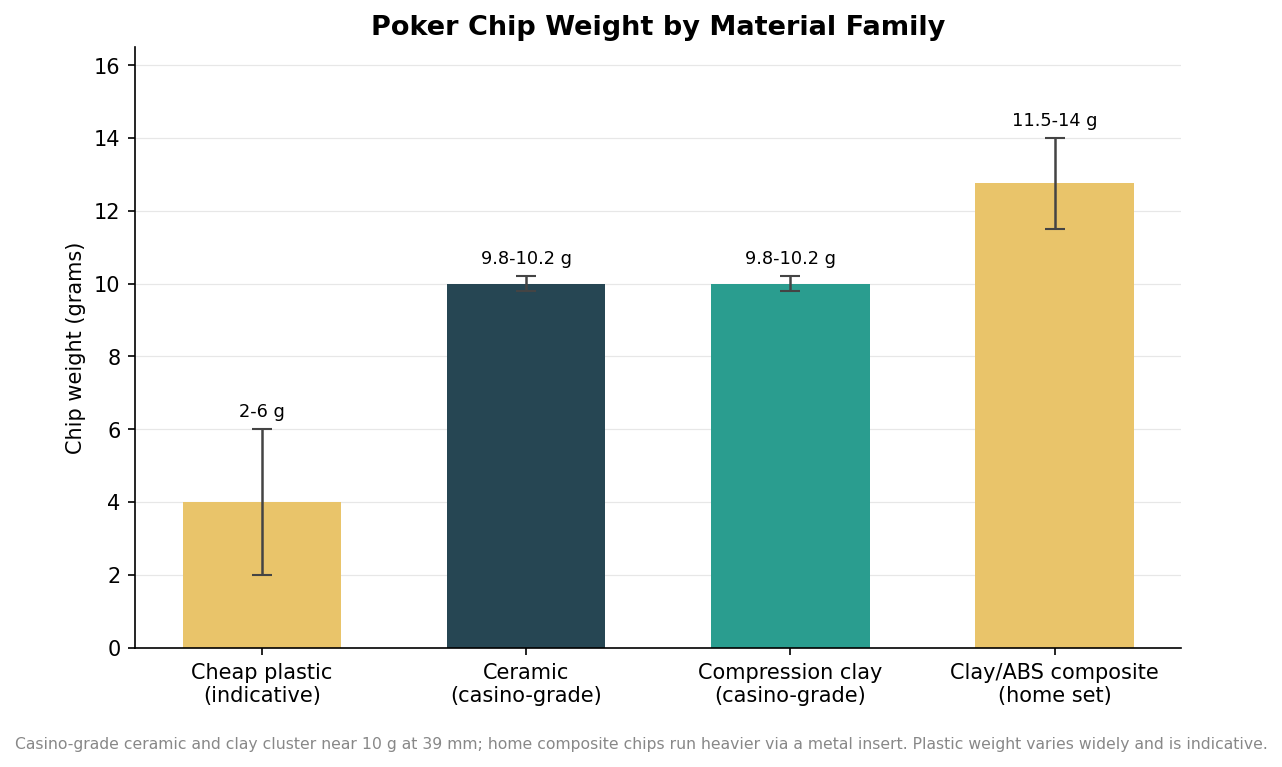
Casino-grade chips converge on a standard: roughly 10 grams at 39 mm, whether the chip is ceramic or compression-molded clay. The heavier chips people associate with a “serious” set are usually home composite chips, an ABS body with a metal insert that brings them into the 11.5 to 14 gram range. Cheap plastic chips sit at the other end, light and variable, often just a few grams. The takeaway is that heavier is not better; it is simply a different construction. Real casinos play with roughly 10-gram chips, and the extra mass in a 14-gram home chip comes from a slug of metal, not from superior material. Diameter is effectively fixed at 39 mm across serious options, so weight is the only dimension that varies much, and it varies for reasons of feel rather than quality.
How each material takes your artwork is the real dividing line
This is where the families genuinely part ways. A ceramic chip is printed edge to edge, directly onto the chip body, so a full-color design can cover the entire face and even wrap onto the rolling edge with no separate label. That makes ceramic the choice when the chip is a canvas, a photo, a bold event graphic, or a logo that fills the surface. A clay chip carries its artwork as a recessed printed inlay set into the center of the face, which reproduces fine detail and small text very sharply, but the design lives inside that inlay rather than covering the whole chip, and the surrounding clay and edge spots are colored, not printed. Composite home chips are usually hot-stamped with foil or carry a printed sticker inlay, which is fine for denominations and simple marks but is the least capable for detailed custom graphics and the most prone to wear at the label. If your design is a full-bleed image, ceramic wins; if it is a precise, detailed emblem framed by traditional edge spots, clay’s inlay holds detail beautifully.
Feel, sound, and durability
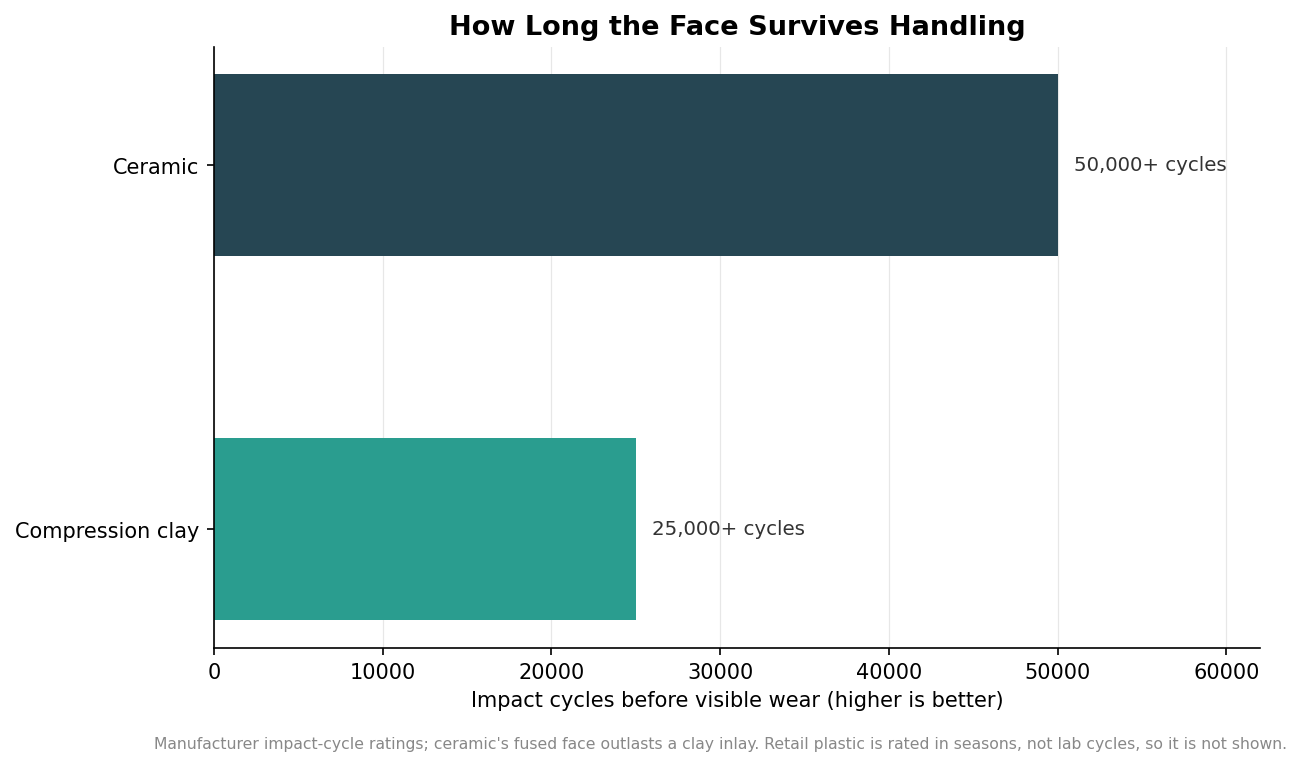
Handling is subjective but consistent. Clay has a natural matte, slightly chalky texture and a classic beveled edge, and it produces the soft riffle and click that players associate with a casino table. Ceramic is smoother, with a clean matte surface and a flat edge, and stacks a little more slickly. Durability is where the numbers separate them: a ceramic face, fused into the chip, is commonly rated around 50,000 impact cycles before visible wear, while a clay inlay is rated closer to 25,000, and cheap plastic chips are measured in seasons rather than cycles because their stickers peel and their edges scuff. None of these is fragile in a home setting, but a chip that will be handled hard for years, at a league or a recurring event, tilts toward ceramic on the strength of the printed face.
Price and minimums
The two casino-grade options are priced surprisingly close. Custom ceramic chips commonly start around $1.10 per chip and custom clay around $1.14, with the real difference showing up in minimum order quantities: ceramic runs are often available from around 300 chips while clay typically starts near 500. Composite home chips are cheaper per unit and available in smaller quantities, which is why they dominate the budget end, and plastic is cheapest of all. Because a usable set runs to several hundred chips across denominations, the minimum order quantity matters as much as the per-chip price for a small event: a 300-chip ceramic minimum is easier to justify for a one-time keepsake than a 500-chip clay minimum you will not use up.
Which material fits which job
The choice follows the purpose. For an event or keepsake chip built around a full-color graphic, a photo, or a logo that fills the face, ceramic is the natural fit, both for the edge-to-edge printing and the lower minimum. For a set meant to feel like a casino, with traditional edge spots and denominations and that familiar riffle, compression clay delivers the authentic weight and texture and holds a crisp inlaid emblem. For a budget home or league set where feel matters more than fine artwork and the order is modest, clay-or-ABS composite gives you the satisfying 11.5-to-14-gram heft and durability at a lower price. Plastic is defensible only for a disposable giveaway where the chips are essentially printed tokens rather than a set anyone will keep.
Decide the artwork first, because it eliminates options faster than anything else: a full-bleed image rules out clay’s inlay, a detailed traditional emblem plays to it, and denominations alone open up composite. Then let feel, durability, price, and minimum order quantity break the remaining tie. Chosen that way, the material serves the design instead of the design fighting the material.