Before you order a custom chip set, two numbers decide whether the set actually works at your table: how many chips you buy, and how those chips split across denominations. A gorgeous custom design does not help if you run out of $25 chips three hands into the night or discover your 300-piece set only comfortably seats six. Both questions have practical answers, and both are easy to get right if you start from the game you actually host.
The per-player math
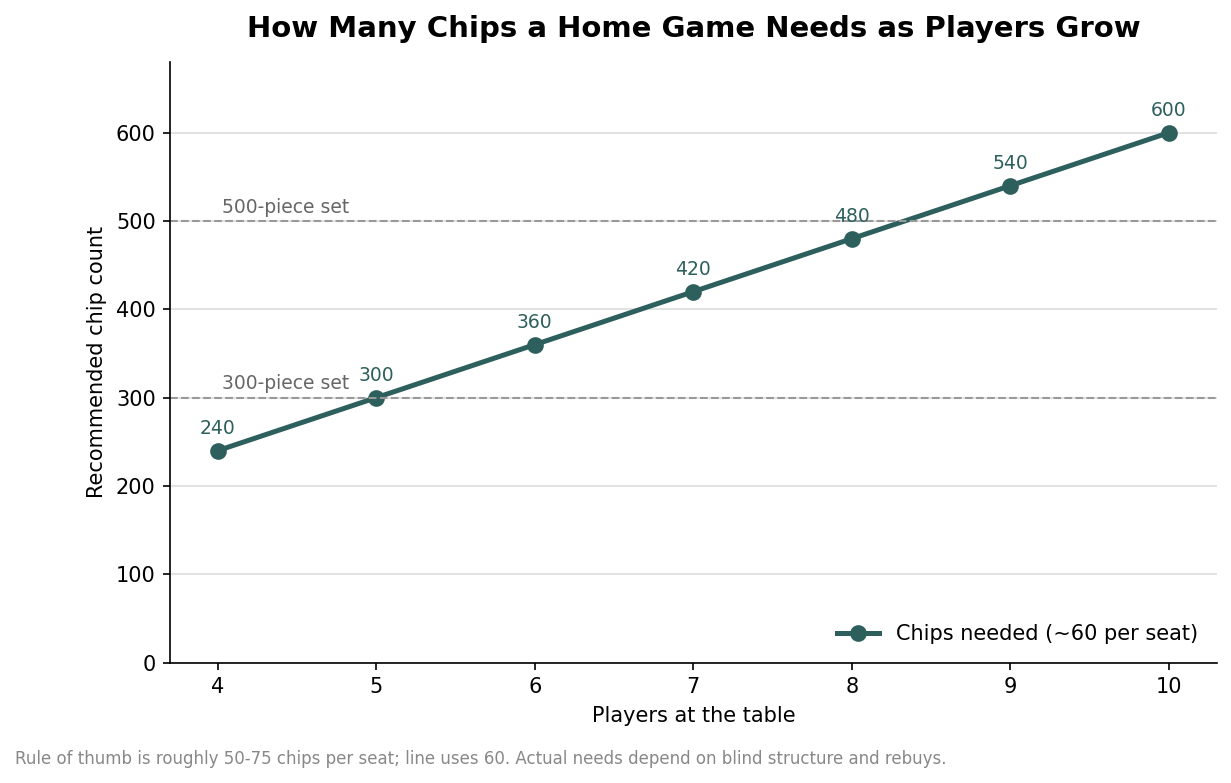
The working rule for a cash game is roughly 50 to 75 chips per seat. That range sounds generous until you remember that players need to make change, post blinds, and stack bets without constantly breaking larger chips. For planning a custom order, budgeting around 60 chips per seat lands in a comfortable middle. That is why the two most common set sizes map to specific table sizes: a 300-piece set covers up to about six players, and a 500-piece set stretches to roughly nine. Once you regularly seat eight or more, or you host rebuy nights where chips pile up in front of the leaders, you outgrow a 300 set faster than the box suggests.
Tournaments change the arithmetic slightly. Because players are eliminated and chips get consolidated through color-ups, a tournament does not need as many low-value chips as a cash game of the same size, but it does need denominations that scale cleanly as blinds climb. If you host both formats, size the set for the cash game, since that is the more chip-hungry of the two.
Choosing denominations and colors
Cash games follow a widely recognized color convention: white is $1, red is $5, blue or green is $25, black is $100, and purple is $500. Black sitting at $100 is about as close to a universal standard as poker chips have. You do not have to follow this scheme, but guests already know it, so departing from it invites confusion at the table. The one denomination worth emphasizing when you order is the workhorse chip. In a typical $1/$2 or $1/$3 home cash game, the $5 and $25 chips do most of the work, so weight your order toward those rather than splitting quantities evenly across every color.
Tournament chips are simply tokens that track who is winning, so their values are detached from real money and climb in larger steps. Common tournament denominations run 25, 100, 500, 1,000 and up, which lets the room strip out small chips as the blinds rise. The practical takeaway for a custom order is that a tournament set needs fewer distinct low chips but benefits from clear, high-contrast colors and edge markings so stacks read correctly from across the table.
Readability is not a cosmetic concern. Across a felt, players judge stack sizes at a glance, and denominations that look alike under dim light cause misreads, slow the game, and occasionally create disputes. When you design a custom set, keep neighboring denominations visually distinct in both body color and edge-spot pattern rather than choosing four shades of blue because they match your branding. A good test is to imagine two stacks of similar height in different denominations sitting side by side under a hanging lamp: if you cannot tell them apart in a second, neither can a tired player at hour four.
Building a starting stack
A starting stack is where denomination choices meet the number of chips each player receives. A widely used tournament example gives every player 3,000 in chips built from about nineteen physical chips: eight $25 chips, eight $100 chips, two $500 chips, and one $1,000 chip. That distribution is deliberate. The smaller chips give players enough granularity to make early bets and antes without breaking a big chip every hand, while the few large chips keep the stack from becoming an unwieldy tower. At typical opening blinds this stack represents on the order of 60 big blinds, which many hosts consider a good balance between room to play and finishing at a reasonable hour.
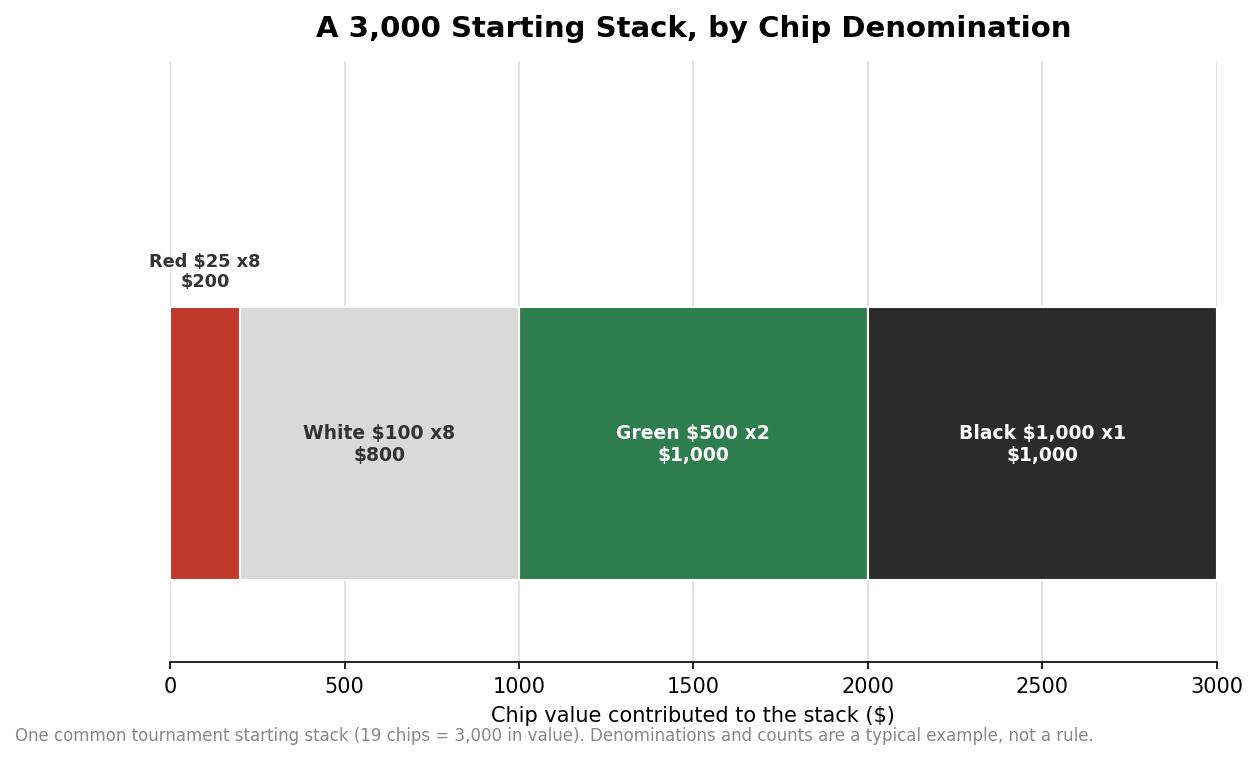
As blinds increase, the tournament runs a color-up: the smallest chips are removed from play and exchanged for larger denominations so the table is not drowning in low chips late in the event. When you plan a custom set for tournaments, make sure you have enough of the middle denominations to absorb those trades, because a set that is heavy on small chips and thin on the next tier up forces awkward change-making exactly when the blinds are getting serious.
What this means when you order a custom set
Translate all of this into a shopping list before you commit a design. Start from your largest realistic table, multiply by about 60 for a cash game, and round up to the next standard set size so you are not perpetually one seat short. Bias the quantities toward the denominations your game leans on, which for most home cash games means extra $5 and $25 chips and comparatively few of the highest values. If you run tournaments, order enough of the middle denominations to survive color-ups, and consider chips with distinct edge spots or coding so denominations stay legible in tall stacks. Finally, buy a modest cushion beyond your headcount. Games grow, chips walk off as keepsakes, and reordering a custom design later to match an existing set is harder than buying a few extra racks up front. Exact per-chip pricing, minimum order quantities, and lead times vary by construction and supplier, so treat any single figure as indicative and confirm it against the weight, inlay, and quantity you actually want.