Three different products get sold under the name “custom poker chips,” and they are not variations on one thing. Ceramic, clay, and composite chips are built differently, printed differently, and priced differently, and the gap between them decides how your artwork reproduces, how the chips feel in a stack, and how long the design survives being shuffled across a felt a few thousand times. Picking by weight alone, which is how most buyers start, misses the decision that actually matters.
Here is how the three families compare on the specifications that change the finished set.
Weight and size are closer than the marketing suggests
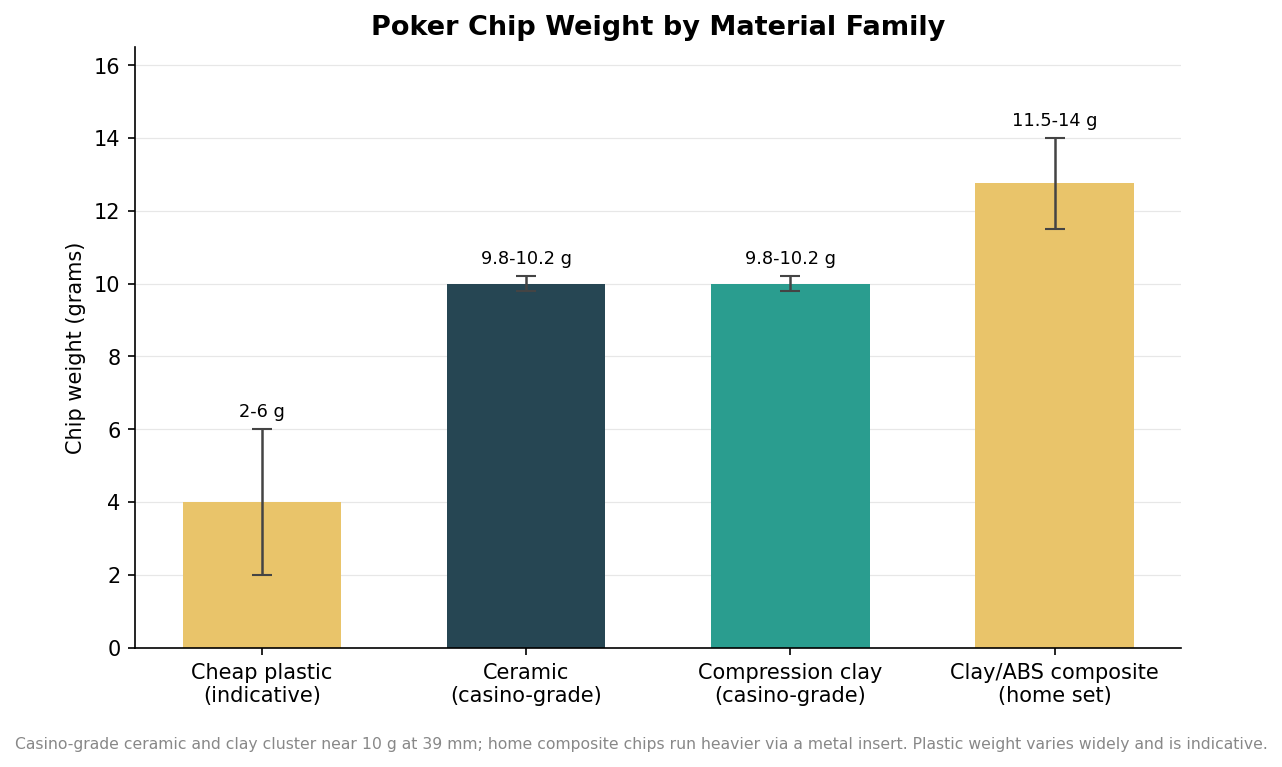
Casino-grade chips converge on a standard: roughly 10 grams at 39 mm, whether the chip is ceramic or compression-molded clay. The heavier chips people associate with a “serious” set are usually home composite chips, an ABS body with a metal insert that brings them into the 11.5 to 14 gram range. Cheap plastic chips sit at the other end, light and variable, often just a few grams. The takeaway is that heavier is not better; it is simply a different construction. Real casinos play with roughly 10-gram chips, and the extra mass in a 14-gram home chip comes from a slug of metal, not from superior material. Diameter is effectively fixed at 39 mm across serious options, so weight is the only dimension that varies much, and it varies for reasons of feel rather than quality.
Casino-grade ceramic and clay both sit near 10 g; heavier home composite chips get their weight from a metal insert.
How each material takes your artwork is the real dividing line
This is where the families genuinely part ways. A ceramic chip is printed edge to edge, directly onto the chip body, so a full-color design can cover the entire face and even wrap onto the rolling edge with no separate label. That makes ceramic the choice when the chip is a canvas, a photo, a bold event graphic, or a logo that fills the surface. A clay chip carries its artwork as a recessed printed inlay set into the center of the face, which reproduces fine detail and small text very sharply, but the design lives inside that inlay rather than covering the whole chip, and the surrounding clay and edge spots are colored, not printed. Composite home chips are usually hot-stamped with foil or carry a printed sticker inlay, which is fine for denominations and simple marks but is the least capable for detailed custom graphics and the most prone to wear at the label. If your design is a full-bleed image, ceramic wins; if it is a precise, detailed emblem framed by traditional edge spots, clay’s inlay holds detail beautifully.
Feel, sound, and durability
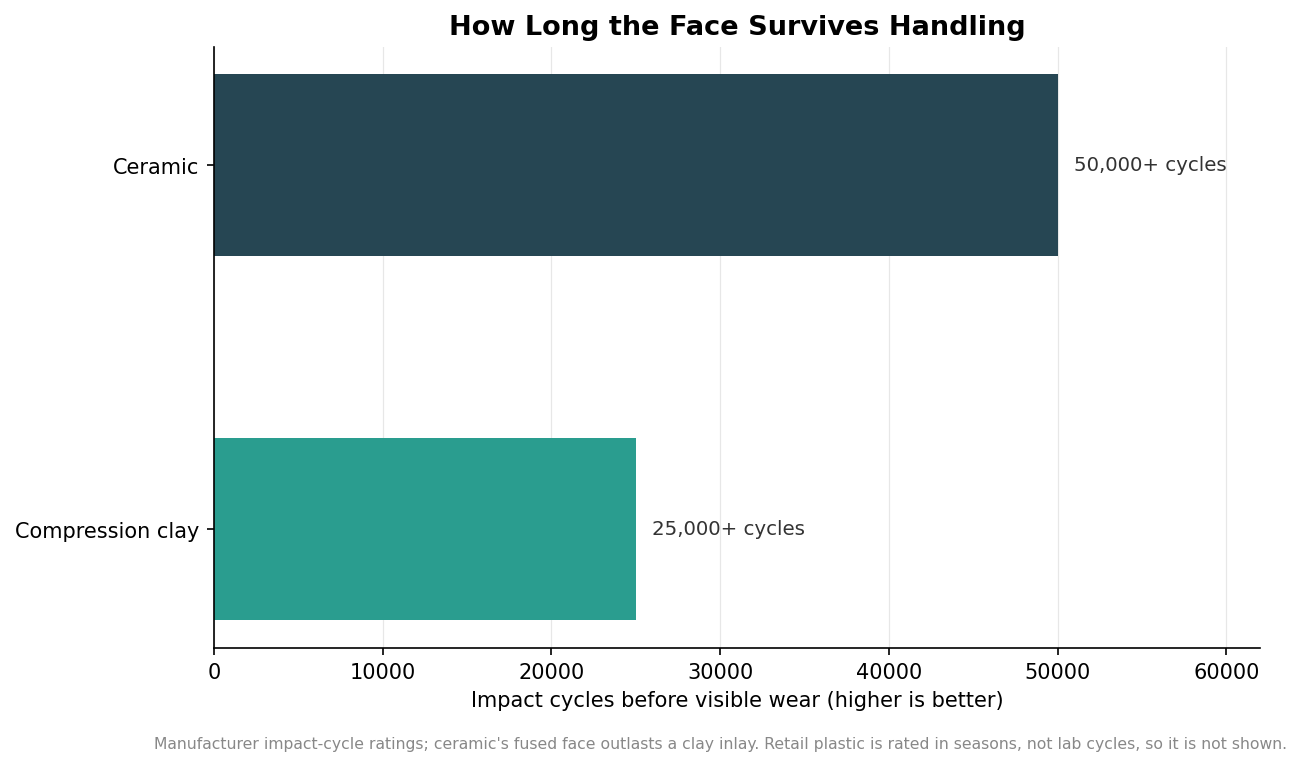
Handling is subjective but consistent. Clay has a natural matte, slightly chalky texture and a classic beveled edge, and it produces the soft riffle and click that players associate with a casino table. Ceramic is smoother, with a clean matte surface and a flat edge, and stacks a little more slickly. Durability is where the numbers separate them: a ceramic face, fused into the chip, is commonly rated around 50,000 impact cycles before visible wear, while a clay inlay is rated closer to 25,000, and cheap plastic chips are measured in seasons rather than cycles because their stickers peel and their edges scuff. None of these is fragile in a home setting, but a chip that will be handled hard for years, at a league or a recurring event, tilts toward ceramic on the strength of the printed face.
A fused ceramic face is rated for roughly twice the handling of a clay inlay before it shows wear.
Price and minimums
The two casino-grade options are priced surprisingly close. Custom ceramic chips commonly start around $1.10 per chip and custom clay around $1.14, with the real difference showing up in minimum order quantities: ceramic runs are often available from around 300 chips while clay typically starts near 500. Composite home chips are cheaper per unit and available in smaller quantities, which is why they dominate the budget end, and plastic is cheapest of all. Because a usable set runs to several hundred chips across denominations, the minimum order quantity matters as much as the per-chip price for a small event: a 300-chip ceramic minimum is easier to justify for a one-time keepsake than a 500-chip clay minimum you will not use up.
Which material fits which job
The choice follows the purpose. For an event or keepsake chip built around a full-color graphic, a photo, or a logo that fills the face, ceramic is the natural fit, both for the edge-to-edge printing and the lower minimum. For a set meant to feel like a casino, with traditional edge spots and denominations and that familiar riffle, compression clay delivers the authentic weight and texture and holds a crisp inlaid emblem. For a budget home or league set where feel matters more than fine artwork and the order is modest, clay-or-ABS composite gives you the satisfying 11.5-to-14-gram heft and durability at a lower price. Plastic is defensible only for a disposable giveaway where the chips are essentially printed tokens rather than a set anyone will keep.
Decide the artwork first, because it eliminates options faster than anything else: a full-bleed image rules out clay’s inlay, a detailed traditional emblem plays to it, and denominations alone open up composite. Then let feel, durability, price, and minimum order quantity break the remaining tie. Chosen that way, the material serves the design instead of the design fighting the material.
Before you order a custom chip set, two numbers decide whether the set actually works at your table: how many chips you buy, and how those chips split across denominations. A gorgeous custom design does not help if you run out of $25 chips three hands into the night or discover your 300-piece set only comfortably seats six. Both questions have practical answers, and both are easy to get right if you start from the game you actually host.
The per-player math
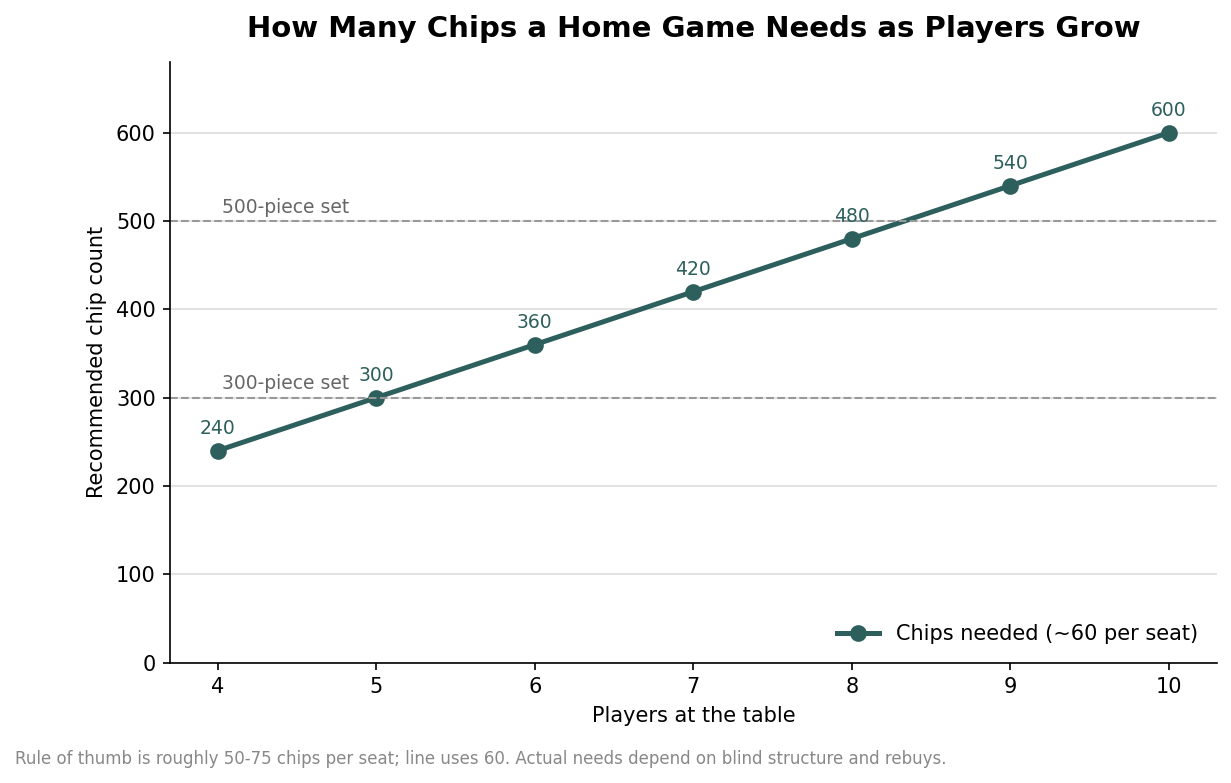
The working rule for a cash game is roughly 50 to 75 chips per seat. That range sounds generous until you remember that players need to make change, post blinds, and stack bets without constantly breaking larger chips. For planning a custom order, budgeting around 60 chips per seat lands in a comfortable middle. That is why the two most common set sizes map to specific table sizes: a 300-piece set covers up to about six players, and a 500-piece set stretches to roughly nine. Once you regularly seat eight or more, or you host rebuy nights where chips pile up in front of the leaders, you outgrow a 300 set faster than the box suggests.
Tournaments change the arithmetic slightly. Because players are eliminated and chips get consolidated through color-ups, a tournament does not need as many low-value chips as a cash game of the same size, but it does need denominations that scale cleanly as blinds climb. If you host both formats, size the set for the cash game, since that is the more chip-hungry of the two.
At about 60 chips per seat, a table outgrows a 300-piece set around six players.
Choosing denominations and colors
Cash games follow a widely recognized color convention: white is $1, red is $5, blue or green is $25, black is $100, and purple is $500. Black sitting at $100 is about as close to a universal standard as poker chips have. You do not have to follow this scheme, but guests already know it, so departing from it invites confusion at the table. The one denomination worth emphasizing when you order is the workhorse chip. In a typical $1/$2 or $1/$3 home cash game, the $5 and $25 chips do most of the work, so weight your order toward those rather than splitting quantities evenly across every color.
Tournament chips are simply tokens that track who is winning, so their values are detached from real money and climb in larger steps. Common tournament denominations run 25, 100, 500, 1,000 and up, which lets the room strip out small chips as the blinds rise. The practical takeaway for a custom order is that a tournament set needs fewer distinct low chips but benefits from clear, high-contrast colors and edge markings so stacks read correctly from across the table.
Readability is not a cosmetic concern. Across a felt, players judge stack sizes at a glance, and denominations that look alike under dim light cause misreads, slow the game, and occasionally create disputes. When you design a custom set, keep neighboring denominations visually distinct in both body color and edge-spot pattern rather than choosing four shades of blue because they match your branding. A good test is to imagine two stacks of similar height in different denominations sitting side by side under a hanging lamp: if you cannot tell them apart in a second, neither can a tired player at hour four.
Building a starting stack
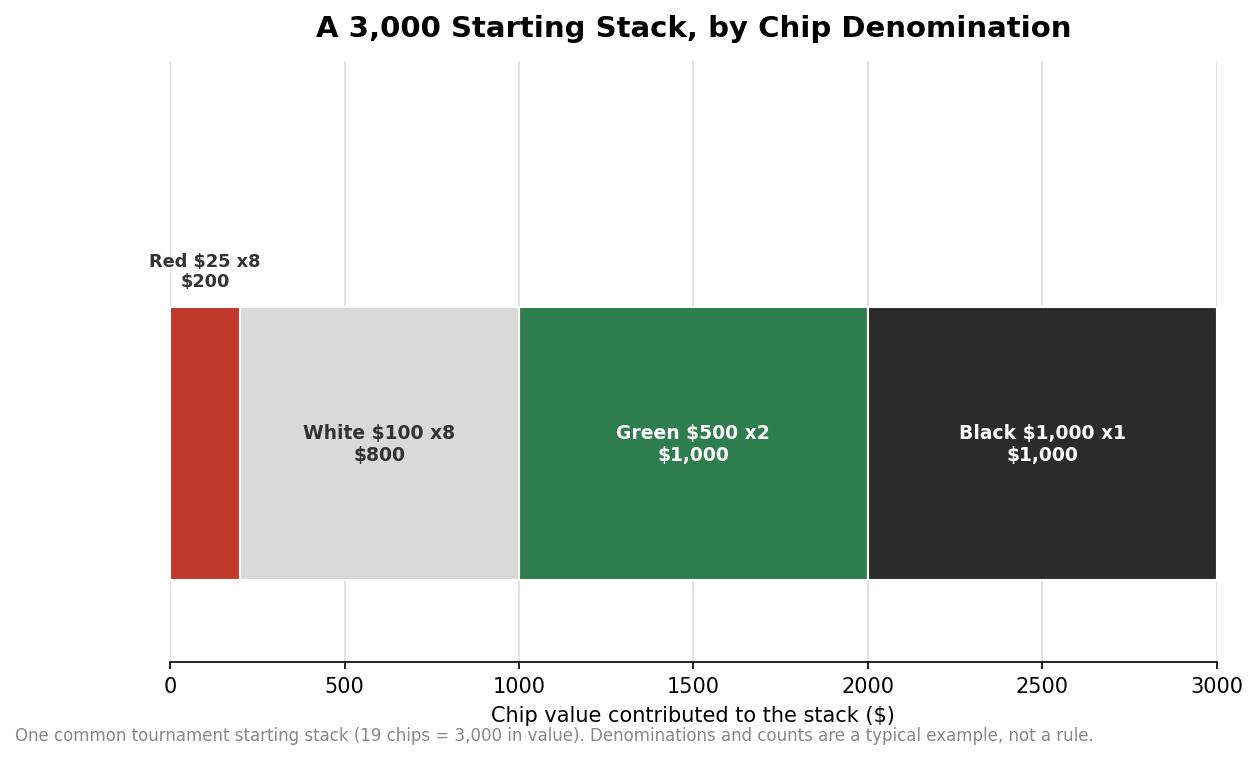
A starting stack is where denomination choices meet the number of chips each player receives. A widely used tournament example gives every player 3,000 in chips built from about nineteen physical chips: eight $25 chips, eight $100 chips, two $500 chips, and one $1,000 chip. That distribution is deliberate. The smaller chips give players enough granularity to make early bets and antes without breaking a big chip every hand, while the few large chips keep the stack from becoming an unwieldy tower. At typical opening blinds this stack represents on the order of 60 big blinds, which many hosts consider a good balance between room to play and finishing at a reasonable hour.
One common 3,000-chip starting stack, broken down by denomination.
As blinds increase, the tournament runs a color-up: the smallest chips are removed from play and exchanged for larger denominations so the table is not drowning in low chips late in the event. When you plan a custom set for tournaments, make sure you have enough of the middle denominations to absorb those trades, because a set that is heavy on small chips and thin on the next tier up forces awkward change-making exactly when the blinds are getting serious.
What this means when you order a custom set
Translate all of this into a shopping list before you commit a design. Start from your largest realistic table, multiply by about 60 for a cash game, and round up to the next standard set size so you are not perpetually one seat short. Bias the quantities toward the denominations your game leans on, which for most home cash games means extra $5 and $25 chips and comparatively few of the highest values. If you run tournaments, order enough of the middle denominations to survive color-ups, and consider chips with distinct edge spots or coding so denominations stay legible in tall stacks. Finally, buy a modest cushion beyond your headcount. Games grow, chips walk off as keepsakes, and reordering a custom design later to match an existing set is harder than buying a few extra racks up front. Exact per-chip pricing, minimum order quantities, and lead times vary by construction and supplier, so treat any single figure as indicative and confirm it against the weight, inlay, and quantity you actually want.
A set that wears blank is the most common complaint in this category, and it is decided entirely at the quote, before a single chip is made.
How a chip actually wears
Chips spend their lives sliding: into stacks, across the table, against each other in a rack. Every one of those contacts lands on the highest point of the surface.
If the highest point is the rim, the rim polishes and the art underneath is untouched. If the highest point is a printed label, the label is the wear surface — and it goes fast.
The failure: art applied proud
A sticker printed and applied on top of the face sits above the surrounding surface by the thickness of itself. It catches every slide, its edge lifts first, and a few months of real play scrub it to a ghost.
You can feel this before you can see it: run a thumbnail across the centre, and if it catches an edge, the process has started.
The fix: recess the inlay
A proper inlay is a printed disc set into a moulded well below the level of the rim, sealed under clear laminate. The rim takes every contact; the art takes none.
Ask for the recess depth on the quote. A supplier who cannot name it is describing a sticker.
The other fixes: dye and foil
Ceramic chips put the art in the surface itself by dye sublimation — there is no layer to lift, and wear is the slow even fading of the surface.
A hot stamp presses metallic foil into the face, so the mark sits at or below the surface. One colour only, and honest about it — a full-colour logo belongs on an inlay or a ceramic face instead.
Judging a set you already own
Thumbnail across the centre: catching means proud, and proud means leaving.
If the set is already fading, a reorder in the same construction buys the same outcome on a delay. Change the construction, not the supplier’s artwork file.
Custom poker chips range from about $0.22 a chip for a single-color hot-stamped set to $1.50 or more for small-batch, edge-to-edge ceramic — and the gap between those numbers comes down to three decisions: material, print method, and order size. Before you request a quote, it helps to know what’s actually driving the price, how many chips you’re required to buy, and how long production takes once your artwork is approved.
This guide pulls current pricing, minimum order quantities, and lead times from several chip manufacturers so you can judge whether a quote you receive is in line with the market. Whether you need a 100-chip set for a poker night or 2,500+ chips for a recurring cash game, the figures below should tell you what a fair price actually looks like.
Hot stamp / direct print MOQ
~50 chips
Clay composite full-set MOQ
500 chips
Ceramic MOQ
100–300 chips
Standard chip weight
11.5g (14g premium)
Source: Custom Made Casino (custommadecasino.com) and Poker Foundry chip specification pages, retrieved August 2026
What drives the price of custom poker chips
Custom poker chips are priced by two things stacked together: the base material and how your design gets applied to it. Hot stamping — pressing a single foil color into a blank clay composite chip — is the cheapest method, starting around $0.22 per chip, but it limits you to one or two ink colors and simple text or a logo outline.
Full-color direct print (sometimes called edge-to-edge or UV print) lets you use unlimited colors, photos, and gradients on a clay composite chip. That process runs roughly $0.69 per chip at 500 chips and drops to about $0.64 per chip once you’re ordering 1,000 or more, because setup costs get spread across a bigger run.
Ceramic chips cost the most because the artwork is fused into the chip surface rather than printed on top, giving a smoother edge-to-edge finish that holds up better to heavy shuffling. Expect around $1.50 per chip on a 100-chip order, falling to roughly $0.79 per chip once you’re past 2,500 chips. If your design is mostly text or a simple mark, hot stamp is the better value; if you’re using a full-color logo or photo, budget for direct print or ceramic instead.
Price per chip ranges from $0.22 for single-color hot stamp up to $1.50 for a small ceramic order, with ceramic falling to $0.79 once you order 2,500+ chips.Source: Custom Made Casino pricing pages (custommadecasino.com/Custom-Poker-Chips and /Custom-Poker-Chips-Ceramic), retrieved August 2026
Minimum order quantities: how many chips you’re actually required to buy
Minimum order quantities vary more by print method than by vendor. Hot stamp and standard full-color direct print chips typically carry the lowest minimums, often around 50 chips, because the equipment doesn’t need a large run to justify setup. A full custom clay composite set — your own colors, denominations, and edge spots — commonly carries a 500-chip minimum, since that’s the batch size most manufacturers mold at once.
Ceramic sits in the middle: minimums land between 100 and 300 chips depending on the vendor, since ceramic tooling is more flexible on run size even though the printing process is more expensive per chip. If you only need a handful of chips — for a wedding favor or a one-off tournament button, say — look for a vendor offering the smaller hot stamp minimum rather than a full ceramic or clay composite set.
How long custom poker chips take to ship
Domestic production for hot stamp, direct print, and ceramic orders generally runs 3 to 7 business days after you approve the artwork proof. Rush service is widely available — some vendors will ship in as little as 1 business day for an added fee, or 1 to 3 days with next-day air on ceramic orders.
If you’re ordering casino-grade chips manufactured overseas, the kind used for full commercial poker rooms, plan very differently. Standard production runs about 10 weeks, largely because 8 of those weeks are ocean freight. Paying for an air-freight rush cuts that to roughly 4 weeks: about a week of manufacturing plus two weeks of priority air shipping. For a home game or corporate event, a domestic supplier is almost always the better fit; for a bar, casino, or large recurring cash game, build that 10-week runway into your timeline if you’re going overseas.
Domestic print or hot-stamp orders ship in about a week; casino-grade overseas orders take roughly 10 weeks unless you pay for an air-freight rush.
Order type
Standard production
Rush option
Domestic hot stamp / direct print
3–7 business days
As fast as 1 business day
Domestic ceramic
3–7 business days
1–3 business days (next-day air)
Overseas casino-grade bulk
~10 weeks (incl. 8 weeks sea freight)
~4 weeks (1 week production + 2 weeks air freight)
Domestic print or hot-stamp orders ship in about a week; casino-grade overseas orders take roughly 10 weeks unless you pay for an air-freight rush.Source: PokerChips.com and Poker Foundry, “How Long Do Custom Poker Chips Take? Timeline (2026)” (pokerfoundry.net/blog/how-long-do-custom-poker-chips-take/), retrieved August 2026
Choosing weight, diameter, and feel
Beyond price, the two specs that change how a chip feels at the table are weight and diameter. Most custom clay composite chips are injection-molded clay over a metal insert, which is what gives them their heft and the “clack” sound compared to plastic chips.
11.5g vs. 14g Clay Composite
The 11.5-gram chip is the industry standard and what most home games and printed poker sets use — it’s light enough to stack quickly and priced to order in full-color sets without a big premium. A 14-gram version is available from most of the same manufacturers as an upgrade; it costs more per chip but gives a denser, more “casino-authentic” feel that regular players notice right away.
Diameter Options
Standard chips run 39mm across, matching the trays, cases, and dealer buttons most manufacturers sell alongside them. Larger ceramic chips are also offered at 43mm and 46mm, typically reserved for high-denomination chips you want to stand out visually rather than for a full set.
Getting your artwork ready for full-color printing
Full-color direct print and ceramic chips can carry a photo or logo on both faces plus text around the edge spots, but the print area is small — usually under 1.5 inches across — so simple marks and short text hold up far better than dense artwork. Vector logos (AI, EPS, or a high-resolution PDF) print cleaner than raster images, especially around the rim where the design has to wrap.
If you’re ordering multiple denominations, decide your color-per-value scheme before you submit art. Most vendors treat each denomination as a separate design, and mismatched color coding is one of the most common reasons a first proof gets sent back for revision, which pushes the order past its quoted lead time.
Frequently asked questions
What’s the cheapest way to order custom poker chips?
Single-color hot stamping on a clay composite chip is the lowest-cost option, starting around $0.22 per chip, and usually has the lowest minimum order — often 50 chips. It works well for a logo, initials, or short text, but it can’t reproduce photos or multi-color artwork; for that you need full-color direct print or ceramic.
How many custom poker chips do I have to order at minimum?
It depends on the print method. Hot stamp and standard full-color direct print typically start around 50 chips. Ceramic minimums usually fall between 100 and 300 chips. A full custom clay composite set with your own denominations and edge spots commonly requires a 500-chip minimum.
What’s the difference between clay composite and ceramic poker chips?
Clay composite chips are injection-molded clay over a metal insert, with your design printed or hot-stamped onto the surface; they’re cheaper and available at lower minimums. Ceramic chips have the artwork fused edge-to-edge into the chip itself, giving a smoother, more durable finish that holds up to heavy shuffling — at a higher per-chip price.
How long does it take to receive custom poker chips?
Domestic orders typically ship 3–7 business days after you approve the artwork proof, with rush options available in as little as 1–3 days. Casino-grade chips manufactured overseas take about 10 weeks standard, or roughly 4 weeks with an air-freight rush.
Should I order 11.5-gram or 14-gram chips?
11.5 grams is the industry standard and works fine for most home games and printed sets. 14-gram chips cost more but feel noticeably denser and more like a casino chip — worth it if your group plays often and cares about table feel.
Can I put different artwork on each denomination of chip?
Yes, but most vendors treat each denomination as a separate design and price it accordingly. Decide your color-per-value scheme before submitting art, since mismatched colors across denominations are a common reason proofs get sent back for revision, which adds time to your overall lead time.
The bottom line
The right custom poker chips for your game come down to matching the print method to your artwork and your budget to your order size. A simple logo on a 50-chip hot-stamped set can cost well under $50 total, while a full-color 1,000-chip clay composite set runs several hundred dollars, and a casino-grade ceramic order needs both a bigger budget and a longer runway. Get quotes from at least two vendors at your actual quantity — published “starting at” prices rarely match what a specific denomination mix and color count will cost — and confirm the lead time in writing before you commit to an event date.
Heft is the first thing anyone notices about a chip, and the number on the listing is the least reliable fact about it.
The marketing number
“11.5-gram casino weight” is the most repeated figure in this category, and it does not describe casino chips. The chips on card-room tables mostly run 8.5 to 10.5 grams.
The 11.5-gram figure belongs to slug-weighted plastic chips — it is the weight of the slug talking, not the quality.
Material weight
A compression-moulded composite or a ceramic chip weighs what it weighs because of what it is made of. The mass is spread across the whole chip, the balance is even, and the sound on a hard table is a low, dull clack.
This is the construction that ages well in nightly play: there is nothing inside to separate, and the surface wears evenly.
Slug weight
An injection-moulded ABS chip is light on its own, so a metal disc is laminated inside to give it heft. The mass concentrates at the centre and the chip rings brighter when it lands.
None of this is a scandal. It is a fraction of the price, the moulded colours are bright, and for an event that handles each chip a dozen times it is the honest recommendation. The scandal is only ever the quote that does not mention it.
The two-second test
Drop a chip flat on a bare wooden table from a few inches. Clack is material; ring is slug.
Do it to your current set before you reorder, because whichever it is, the new chips need to match — a mixed rack sounds wrong every time the pot is pushed.
What to ask for on a quote
The construction by name — composite, ceramic or slug-weighted ABS — rather than a gram figure alone.
A supplier who volunteers where the weight comes from has specified their product. One who answers with “casino weight” has specified a listing.